
Ordering 10, 50 or 500 T-Shirts: Which Is the Best Option?
Rodrigo
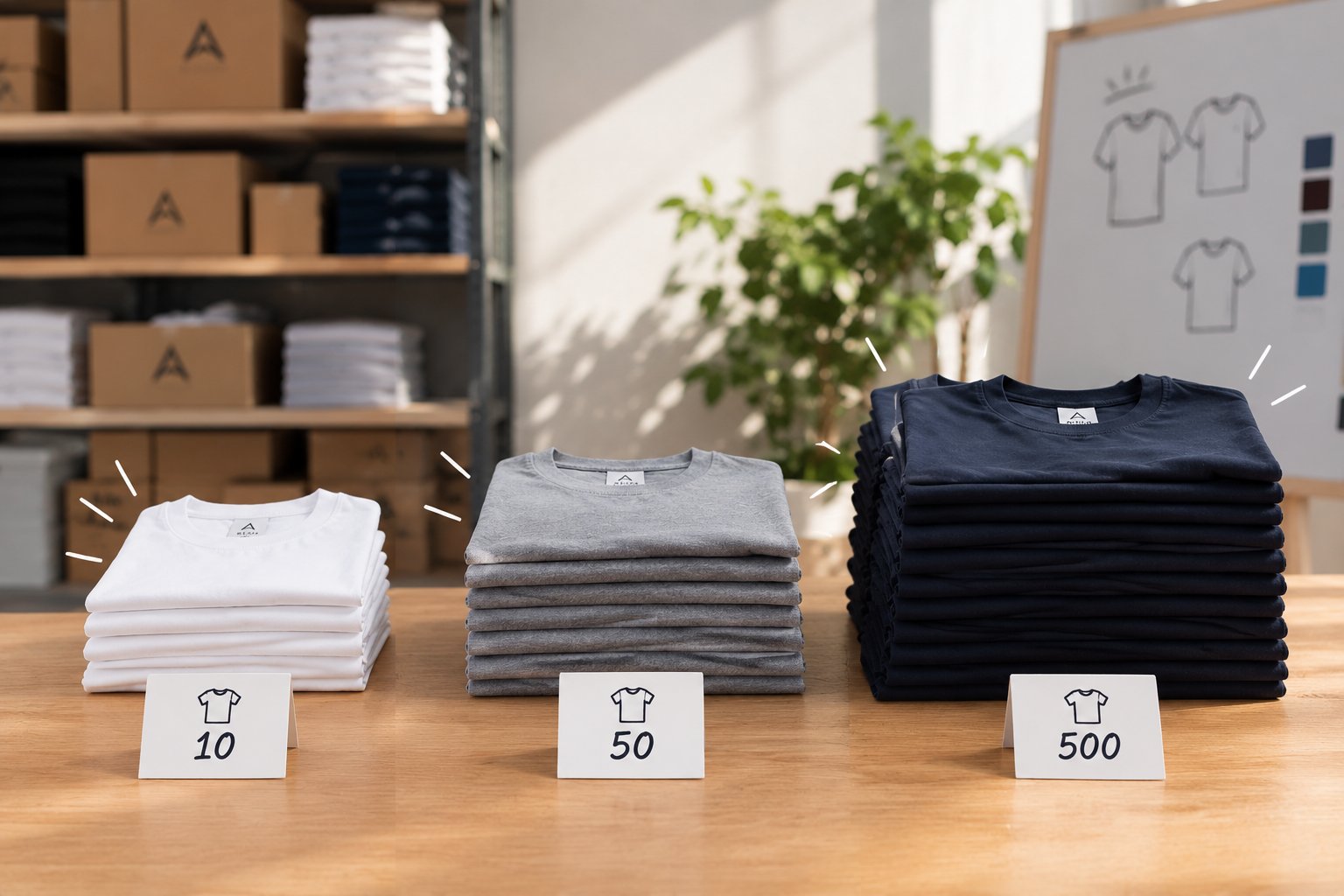
When a company, team or organisation needs personalised T-shirts, one of the first decisions is working out how many units to order.
10?
50?
100?
500?
There is no universally right quantity.
The best option depends on the use, the number of people involved, how often the garments will be worn, the possibility of reordering and, of course, the budget available.
An order of 10 T-shirts can make sense for a small team or for testing an idea.
50 units may suit a larger team, an event or a promotional activity.
500 T-shirts may be needed for a large campaign, a sporting event, an event with many participants or a merchandising operation.
On top of that, increasing the quantity can change the unit price, so it is worth comparing different scenarios before closing the order.
In this guide we explain what to consider before choosing the right quantity for your project.
1. Start with the use, not the quantity
The first question should not be:
“How many T-shirts can I buy?”
It should be:
“What do I need the T-shirts for?”
The use will help determine the quantity needed.
You may need garments for:
- a small team;
- the staff of a company;
- an event;
- a charity walk;
- a promotional campaign;
- a club;
- an association;
- merchandising;
- a brand;
- a marketing initiative.
Different uses naturally lead to different quantities.
2. When does it make sense to order 10 T-shirts?
An order of around 10 units can be right when the group is small or when you only need a limited set of garments.
It can make sense for:
- small teams;
- meetings or specific activities;
- event teams;
- samples for internal use;
- small groups;
- first tests of a project.
Imagine a company with eight employees that wants to create personalised garments for a particular activity.
It does not necessarily need to order dozens or hundreds of units.
In that case, a small order can meet the need exactly.
Advantages of a small order
A small quantity lets you start with a smaller project and see how the garment and the customisation work.
It can be particularly useful when you are still testing:
- a new design;
- a new garment;
- a new identity;
- a particular use.
It can also be a starting point ahead of a larger order later on.
3. When does it make sense to order 50 T-shirts?
50 units already cover needs on a larger scale.
It can be a useful quantity for:
- company teams;
- small events;
- local campaigns;
- associations;
- clubs;
- promotional activities;
- organised groups.
A team of 40 employees, for example, may need around 50 garments to allow for some extra margin.
At an event, 50 units can be enough for the organising teams, the participants or a smaller promotional activity.
50 units: think about sizes too
As the quantity goes up, the size breakdown starts to matter more.
Knowing you need 50 T-shirts is not enough.
You may need, for example:
- 5 × S;
- 15 × M;
- 18 × L;
- 9 × XL;
- 3 × XXL.
The breakdown naturally depends on the people who will wear the garments.
At TShirtPro, you can split the units across the different sizes within the order configuration.
4. When does it make sense to order 500 T-shirts?
500 units represent a very different need.
Here we are usually talking about larger-scale operations.
It can be the right quantity for:
- large events;
- charity walks;
- races;
- festivals;
- promotional campaigns;
- companies with many employees;
- clubs;
- associations;
- merchandising;
- brands;
- marketing initiatives.
A race with hundreds of participants, for example, may need hundreds of T-shirts with the same design.
In the same way, a nationwide promotional campaign may call for a significantly larger production run.
What changes in an order of 500 units?
Planning becomes more important.
You need to keep a closer eye on:
- quantity;
- size breakdown;
- colours;
- customisation;
- files;
- deadline;
- logistics.
The larger the order, the more important it is to have the details settled before production.
5. Does quantity affect the price?
Yes.
Quantity is one of the factors that can directly affect the unit price of an order of personalised T-shirts.
As the number of units goes up, there may be different price brackets.
Even so, the price does not depend on quantity alone.
The following can also affect the figure:
- the T-shirt model;
- the colour;
- the size of the customisation;
- the number of customised areas;
- the configuration chosen.
That is why an order of 50 T-shirts with a small front print should not be compared directly with 50 T-shirts with a large print on the front and the back.
You need to compare equivalent configurations.
6. What if I am between two quantities?
This is a fairly common situation.
Imagine you need garments for 40 people.
You might think:
“Do I order 40 or 50?”
Or you need 450 garments:
“Would it be better to order 450 or 500?”
In situations like these, it is worth simulating different quantities and seeing how the unit price and the total investment change.
At TShirtPro, the configurator lets you try different quantities, models and print sizes and check the corresponding price.
That allows you to make the decision with more information.
7. Do not order on unit price alone
A lower unit price can always look more appealing.
But that does not mean you should buy more garments than you actually need.
Imagine that:
- 50 units → cover the need;
- 100 units → come at a lower unit cost;
- 500 units → have an even lower unit price.
If the company only needs 50 garments, buying 500 just to bring the unit price down may not make sense.
It is important to look at:
unit price + total investment + quantity actually needed
The goal is not simply to find the lowest unit price.
It is to find a quantity that suits the project.
8. Allow a margin for replacements or new people
In some situations it can be useful not to order exactly the number of people you have.
For example, a team of 45 employees may choose to have a few extra units.
This can be useful for:
- new employees;
- replacing garments;
- sizing mistakes;
- use at events;
- immediate future needs.
The margin needed naturally depends on the context.
For a one-off order, it may not be relevant.
For garments in continuous use, it can be more useful.
9. Quantity also depends on how often the garments are worn
A T-shirt worn every day may need rotation.
A T-shirt intended for a single event has a different requirement.
For example:
Occasional use
Fewer units per person may be enough.
Frequent use
It can make sense to have several garments per employee.
One-off event
The quantity tends to be tied more closely to the number of participants.
Merchandising
The quantity may depend on the sales or distribution forecast.
So the number of people is not the only factor.
How often the garments are worn should also come into the decision.
10. Think about sizes before settling the quantity
An order of 500 T-shirts takes much more than knowing that it is 500 units.
The breakdown has to be prepared.
For example:
| Size | Quantity |
|---|---|
| S | 60 |
| M | 140 |
| L | 170 |
| XL | 100 |
| XXL | 30 |
This breakdown is only an example.
Every company, event or group will have different needs.
What matters is gathering this information before finalising the order.
11. Choose the right model too
Quantity should not be separated from the choice of garment.
It can make sense to order:
- a standard T-shirt;
- a Premium T-shirt;
- a technical/sports T-shirt;
- another available model.
TShirtPro itself structures different product solutions for different uses, including the Classic, Premium and Sport models and other categories still growing.
A large quantity of technical T-shirts for a race, for example, answers a different need from a small order of Premium T-shirts for a sales team.
12. 10, 50 and 500 can stand for different goals
A simple way to think about quantity is this:
10 T-shirts
Small team / test / specific use
Ideal when you need few garments and want to start with a small quantity.
50 T-shirts
Team / association / small event / campaign
A mid-range quantity for larger groups or activities involving several people.
500 T-shirts
Large event / campaign / merchandising / organisation
Suitable when there is a need for scale.
This does not mean these quantities are rules.
They are simply examples to help structure the decision.
13. What if I need more than 500?
The logic is exactly the same.
500, 1,000 or more units may be needed in larger-scale operations.
In these cases, planning becomes even more important.
You may need to consider:
- different sizes;
- several colours;
- different delivery locations;
- specific deadlines;
- packing;
- logistical needs.
For large volumes, the configuration should be looked at in more detail.
14. Is it worth ordering more now to avoid repeating later?
It can make sense in certain situations.
For example, a company knows it will be hiring more employees in the coming months.
Or there is an event that comes round regularly.
Or a campaign will run in different phases.
In those cases, ordering a larger quantity can reduce the need to repeat the process within a short space of time.
But it is important to balance that against how the garments will actually be used.
The goal should not be to build up stock with no need for it.
15. Think about future orders
A first order can serve as the basis for those that follow.
If the company finds:
- the right model;
- the right colour;
- the right size;
- the right customisation;
repeating the solution becomes simpler.
At TShirtPro, the online configuration process lets you see the details of the order and repeat or adjust different configurations as needed.
So it is worth thinking of the first order as a way of setting a line for the future as well.
16. The mock-up still matters at any quantity
Whether it is an order of 10 or 500 T-shirts, it is important to know how the design will be applied to the garment.
The difference is that, in a large order, a small mistake can affect many units.
At TShirtPro, the files you send are reviewed and a digital mock-up is prepared before production, for approval.
The mock-up lets you check:
- position;
- size;
- proportion;
- visual arrangement.
Only after approval can the process move on to production.
Conclusion: the right quantity is the one that meets your need
Ordering 10, 50 or 500 T-shirts is not just a question of price.
Each quantity can answer a different reality:
10 units for small groups or specific needs.
50 units for teams, events and mid-sized campaigns.
500 units for events, campaigns, merchandising or larger-scale operations.
The best decision comes from finding the balance between the quantity needed, the use, the sizes, the model, the customisation and the total investment.
At TShirtPro, you can try different configurations online, adjust the quantity and check the corresponding price before finalising the order.
Ready to create your custom t-shirts?
Configure online and get a free mockup within 24h.
Start configuring