How an Agency Can Work with a Textile Production Partner
Rodrigo
How an Agency Can Work with a Textile Production Partner
For many marketing, communications, events or design agencies, winning new clients is not the only challenge.
Once a project is signed off, every element has to be produced exactly as planned.
When merchandise, custom clothing or textile production is involved, that can mean managing styles, sizes, colours, files, customisation, quantities, deadlines and deliveries.
This is where a textile production partner comes in.
Instead of handling the whole production in-house, the agency can rely on a specialist partner to turn the client-approved project into finished garments ready to deliver.
The agency keeps the client relationship and the project management.
The partner handles production.
This split can make the process simpler and let each side focus on what it does best.
What is a textile production partner?
A textile production partner is a company that supports agencies, resellers and other professionals in delivering their clients' custom clothing projects.
Rather than selling only to the end consumer, the partner works as an extension of the agency's operation.
The logic can be simple:
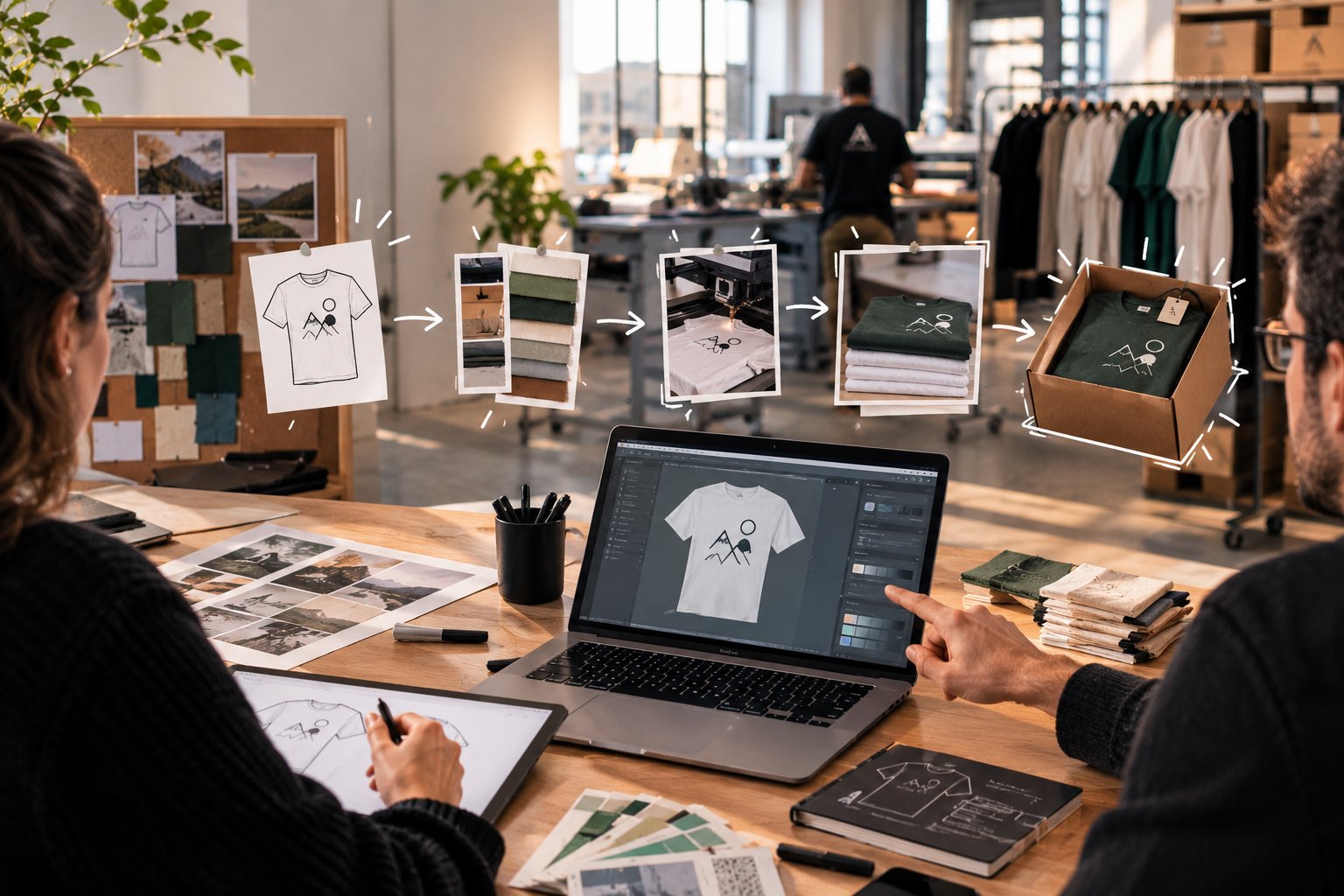
Agency → Client → Project → Production → Delivery
The agency defines and oversees the project.
The production partner handles the operational side.
Depending on the project, that can include:
- production set-up;
- customisation of the garments;
- managing quantities;
- organising sizes;
- production control;
- packing;
- dispatch.
For the agency, the aim is to cut operational complexity without losing control of the client relationship.
1. The agency keeps the client relationship
One of the main advantages of this model is the separation between commercial management and production.
The agency remains responsible for the client, the concept and the project.
The production partner steps in to execute.
Say an agency is asked to produce 500 custom T-shirts for a campaign.
The agency can:
- understand what the client needs;
- develop the concept;
- prepare the design;
- set quantities and specifications;
- manage sign-off;
- hand the project over to production.
The textile partner handles the execution of the order.
So the agency does not necessarily need to build its own production set-up to offer this kind of service.
2. A partner can increase the agency's capacity
An agency can have small jobs one week and high-volume projects the next.
Having a production partner makes for a more flexible operation.
The agency can work with:
- small quantities;
- dozens of garments;
- hundreds of units;
- repeat projects;
- larger campaigns.
This can matter in particular to agencies working with different types of client.
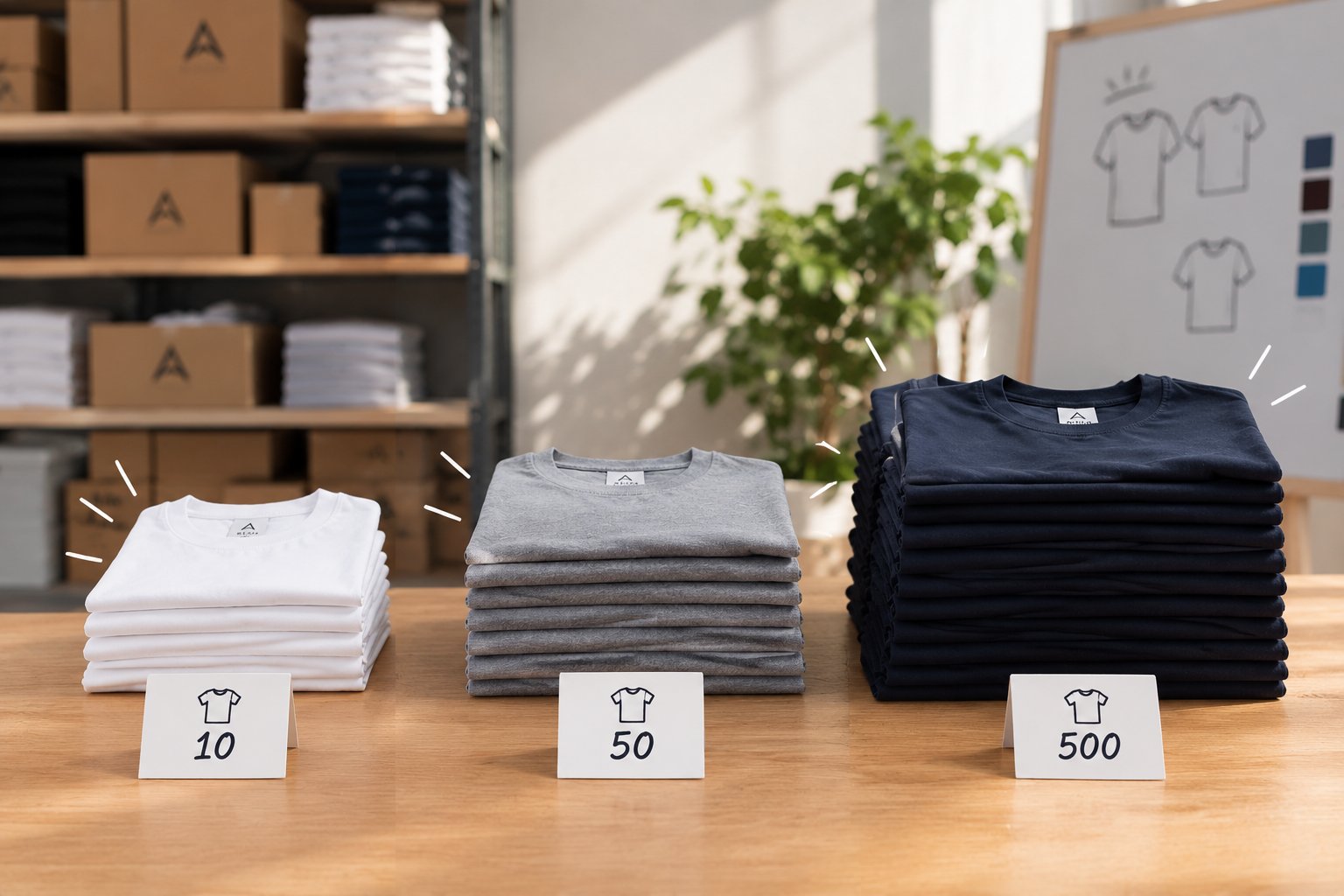
A promotional campaign may need 50 pieces.
An event may need 200.
A brand activation may call for 500.
A larger campaign can run into the thousands.
In that case the production supplier becomes an extension of the agency's operational capacity.
3. Avoid adding a new layer of complexity
An agency can try to handle all production in-house.
But that means dealing with equipment, materials, prep, quality control, storage, maintenance and production processes.
For an agency whose core business is marketing, communications or design, that can mean an extra structure that does not always make sense.
Working with a specialist partner keeps the two areas apart.
The agency creates and manages.
The partner produces.
That specialisation can make the operation simpler.
4. The partner has to understand how agencies work
An agency normally runs several projects at once.
That means it needs clear answers, organised information and the ability to handle changes.
A production partner has to work to B2B logic and understand that there is often an end client behind every request.
It is important to communicate clearly about:
- product;
- quantity;
- sizes;
- colours;
- customisation;
- files;
- deadlines;
- delivery.
The better organised the process between agency and supplier, the less coordination it takes.
5. Configuring an order should be simple
One area where technology helps is in configuring the order.
Instead of relying solely on email threads, it helps to have a system where you can set:
- item;
- quantity;
- sizes;
- colour;
- customisation;
- placement;
- dimensions.
At TShirtPro, the ordering model was built precisely to simplify this configuration and to show the price according to the options selected.
For an agency, that means putting an order together faster before passing it to production.
6. Pricing has to be predictable
When an agency sells a service to a client, it needs to know the production costs behind it.
That is why price transparency matters.
Ideally, the agency should be able to see how different decisions change the cost:
- quantity;
- style;
- size of the customisation;
- number of print areas;
- other configuration options.
A configurator that shows the price straight away makes this stage easier.
The agency can test scenarios before closing the quote with the client.
7. A consumption-based model can make the relationship more efficient
For agencies working regularly with textile production, the logic can differ from a one-off order.
Instead of treating each project as a completely separate relationship, you can set up a consumption-based partnership model.
In that approach, the production volume the agency builds up over time can be taken into account when setting commercial terms.
This can matter in particular to agencies handling several clients and recurring projects.
The more predictable the volume, the more sense it makes to structure a long-term commercial relationship.
A model like this is of course set according to the commercial terms that apply to each partner.
8. The partner has to handle different garments
An agency's clients can have very different needs.
Some want T-shirts.
Others are after sweatshirts.
Others hoodies or jackets.
A broader range therefore lets the agency take on more projects without hunting for a new supplier every time.
The TShirtPro range has grown beyond T-shirts to categories such as sweatshirts, hoodies, zip hoodies and outerwear.
For an agency, that means running different projects under the same production logic.
9. Consistency across orders is essential
Picture an agency working with a brand over several months.
First it produces T-shirts.
Then sweatshirts.
Later hoodies.
If every order is handled completely differently, holding the visual identity together gets harder.
So the partner has to keep consistency in:
- style;
- colour;
- customisation;
- logo placement;
- quality;
- how the design is applied.
The agency can then work with the same partner across different campaigns and projects.
10. The mock-up has to be part of the process
For an agency, the mock-up carries extra weight.
Before production, you have to be sure that what was shown to the client is what will actually be made.
A mock-up lets you check:
- how the logo is applied;
- placement;
- size;
- proportions;
- visual layout.
At TShirtPro there is a mock-up for approval before production.
That adds an important validation step between the creative project and production.
11. The agency can focus on what adds most value
With production organised, the agency can spend more time where it adds value for the client:
strategy
creative
branding
design
campaigns
event management
The production partner takes on the operational side.
This split is particularly useful when clothing is only one part of a larger project.
An agency may be working on a brand launch, for example, and have to produce:
- T-shirts;
- hoodies;
- promotional material;
- team kit;
- merchandise.
Clothing becomes part of the campaign without turning the agency into a production company.
12. A good partner has to cope with large volumes
Not every project is small.
An agency can start with an order for 30 pieces and, a few months later, have to produce 1,000 for another client.
So being able to respond to different volumes matters.
On larger projects, the partner has to handle in an organised way:
- large quantities;
- size breakdowns;
- different colours;
- different items;
- consistent customisation;
- deadlines;
- dispatch.
For an agency, that capacity can make a real difference to what it can offer its own clients.
13. Logistics is part of the service too
Producing is only one part of the process.
After production, the garments have to reach the right place.
Depending on the project, that can mean:
- the agency's warehouse;
- the client's premises;
- the event venue;
- another agreed delivery point.
In certain production models there may also be the option of working directly with different destinations, according to the project.
The better organised this process, the less logistics work falls to the agency.
14. The partner can work as an extension of the agency
This is perhaps the best way to understand the idea.
A production partner does not have to be just a supplier.
It can work as an operational extension of the agency.
The agency brings:
client + strategy + creative + project
The partner brings:
production + customisation + organisation + dispatch
Together they deliver a complete solution to the end client.
15. Which agencies benefit from this model?
This model can be especially relevant for:
- marketing agencies;
- communications agencies;
- event agencies;
- branding agencies;
- merchandise companies;
- design studios;
- promotional companies;
- custom clothing resellers.
It can also make sense for companies that regularly get requests for custom clothing but have no production of their own.
16. How do you choose the right partner?
Before setting up a partnership, it is worth weighing up several criteria.
Product range
Can they produce the garments your clients are looking for?
Production capacity
Can they handle different volumes?
Customisation
Do they have the right options for different types of project?
Mock-up
Is there a validation step before production?
Price
Can you get clear information to prepare your quotes?
Deadlines
Is there hard information on production times?
Logistics
Can delivery be arranged to suit the project?
Repeat runs
Is it easy to produce the same project again later?
Communication
Is the way of working simple and predictable?
17. How does a partnership work in practice?
A simple process can look like this:
1. The agency receives the client's request
↓
2. Defines the project
↓
3. Chooses the garments and quantities
↓
4. Prepares the design
↓
5. Configures production
↓
6. Approves the mock-up
↓
7. Production runs
↓
8. The garments are packed and dispatched
↓
9. The agency delivers to the client
Each partner keeps its role and the project moves forward in an organised way.
Conclusion: a good production partnership can simplify the whole project
For an agency, selling custom clothing does not have to mean producing in-house.
Working with a textile production partner separates the creative and commercial side from operational execution.
The agency keeps the client relationship and manages the project.
The partner handles production, customisation and logistics.
With a simple process, clear pricing, capacity for different volumes, a range of clothing options and a mock-up validation step, the partnership can become an important part of an agency's operation.
At TShirtPro the aim is to simplify exactly this part of production, through an online configuration experience, order tracking and mock-up approval before production.
Ready to create your custom t-shirts?
Configure online and get a free mockup within 24h.
Start configuring