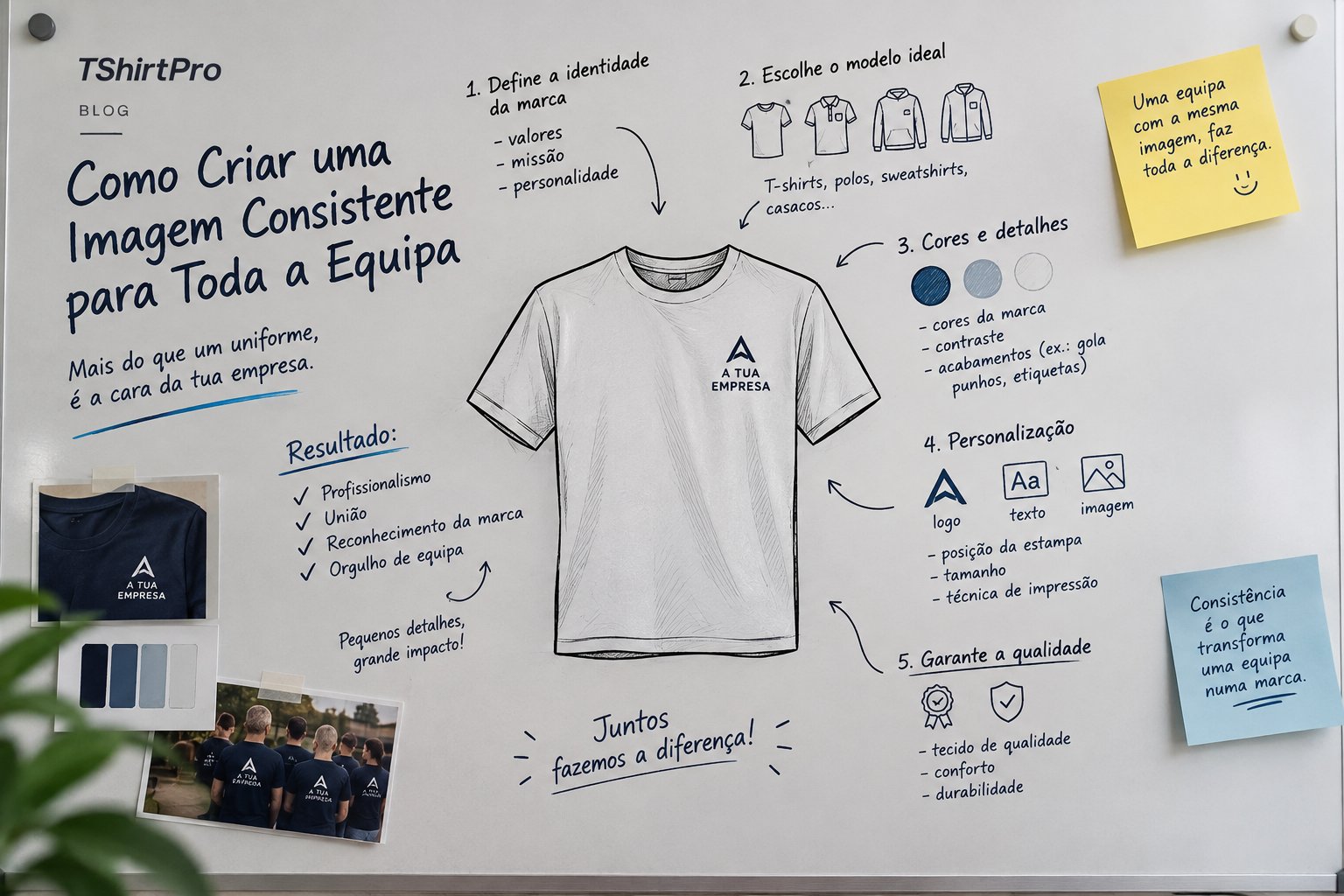
When several employees represent the same company, the way they present themselves also shapes the brand's image.
A custom T-shirt, a polo, a sweatshirt or a jacket may be different garments, but they should still convey the same visual identity.
That is where consistency comes in.
A team does not necessarily have to wear exactly the same garment every day.
There can be more than one model, different seasons of the year and different roles within the company.
What matters is having a visual thread that makes the brand recognisable in different settings.
At TShirtPro, being able to combine different garments — T-shirts, sweatshirts, hoodies and jackets — makes it possible to build more complete clothing solutions while keeping a coherent visual identity.
This guide shows how to create a consistent image for the whole team through custom clothing.
1. Start with the company's visual identity
Before choosing the clothing, start with the brand itself.
The logo, the colours and the visual elements the company already uses should be the basis for the clothing.
Not every element of the visual identity has to appear on every garment.
The aim is to pick the elements that work best on clothing.
For example:
- logo;
- primary colours;
- secondary colours;
- typography;
- graphic elements;
- symbols associated with the brand.
The clearer the visual identity, the easier it is to build a consistent clothing line.
2. Choose a colour palette
Colour is one of the elements that contributes most to coherence.
Imagine a team where every employee wears a garment in a completely different colour.
Even with the same logo on all of them, the overall look can end up uneven.
It is worth defining a small colour palette in advance.
For example:
Primary colour: brand colour
Complementary colours: white, black, grey or other tones from the identity
This does not mean every garment has to be identical.
A black T-shirt, a grey sweatshirt and a jacket in the corporate colour can still work as part of the same line.
3. Set rules for the logo
One of the most common mistakes is treating each garment on its own.
The logo ends up appearing in different sizes, positions and proportions, which makes the image inconsistent.
To avoid that, set a few rules.
For example:
Placement: left chest
Size: discreet and proportional
Version: always the same version of the logo, unless there is a specific reason
Colours: the main version or a version adapted to the background
These rules can be applied across different garments.
That way, when a sweatshirt replaces a T-shirt or a polo gives way to a jacket, the brand keeps the same visual presence.
4. Not everyone has to wear exactly the same garment
Consistency does not mean absolute uniformity.
A company can have very different needs from one department to another.
What matters is that there is a common logic across all these garments.
The wider TShirtPro range makes it possible to plan clothing by use, rather than tying the whole company to a single model.
5. Think of the clothing as a system
Instead of choosing each garment separately, it can be more effective to think in terms of a clothing line.
For example:
Summer
Custom T-shirt
Mid-season
T-shirt + sweatshirt
Winter
Sweatshirt + jacket
Informal setting
T-shirt + hoodie
This way, different garments can serve different purposes without losing the company's visual identity.
6. Choose the right model for each role
Consistency also means choosing the right garment for each context.
A T-shirt can work well for a team in an informal environment.
A polo may make more sense for a sales or customer-facing team.
A sweatshirt can add a layer during colder periods.
A jacket may suit employees who work outdoors.
The choice should not be based on appearance alone.
It is also important to consider:
- role;
- how often it is worn;
- work environment;
- temperature;
- level of formality;
- comfort.
7. Keep the customisation visually coherent
Even with different garments, the customisation can follow the same logic.
For example:
T-shirt: logo on the chest
Sweatshirt: logo on the chest
Jacket: logo on the chest or a position defined for that garment
That way, the brand keeps a similar presence across different items.
There can also be an extra application on the back or the sleeve when it makes sense for the way the garment is used.
The key is to stop each garment from looking like it belongs to a completely different collection.
8. Think about the size of the customisation
The size of the design also affects consistency.
A small logo on one garment and a huge print on another creates a very noticeable visual gap.
The size should be adapted to the garment while keeping a common logic.
A good rule is to always think about the relationship between:
logo size + garment size + position of the customisation
The mock-up is particularly useful at this stage, because it shows the application before production.
9. Use the mock-up to check the set as a whole
When there are several garments for the same team, looking at each one on its own is not enough.
It helps to see how they work together.
Imagine:
- black T-shirt;
- black sweatshirt;
- black hoodie;
- black jacket;
with different logo sizes and positions.
Each garment may look right on its own, but side by side they can reveal differences that were not obvious before.
The mock-up makes it possible to check the visual application before production and helps keep a coherent line across different garments.
At TShirtPro, there is a mock-up for approval before production.
10. Adapt without losing the identity
A company can have different teams, departments and uses.
That does not mean everyone has to wear exactly the same clothing.
There can be a shared identity with small adaptations.
11. Avoid too many colours and elements
The more elements added, the harder it becomes to keep things visually simple.
A garment can carry:
- a logo;
- a slogan;
- several partners;
- images;
- different colours;
- text;
- contact details.
But not all of it has to be there at once.
For a corporate team, a simpler solution often projects a more organised image.
Start with the essentials and add other elements only when there is a clear need.
12. Think about the back of the garment too
The front is usually where the main logo goes.
But the back can serve another purpose.
It can be used for:
- the company name;
- the website;
- a slogan;
- the team's role;
- a message;
- event identification.
For teams working outdoors or at events, printing on the back can increase the brand's visibility.
What matters is having a logic.
If some garments carry information on the back and others do not, there should be a clear reason for the difference.
13. Stay consistent when the season changes
One of the biggest advantages of building a clothing line is keeping the identity throughout the year.
In summer:
T-shirt
In autumn:
T-shirt + sweatshirt
In winter:
Sweatshirt + jacket
In a more informal setting:
Hoodie
The clothing changes.
The brand stays recognisable.
This approach also avoids starting the branding process from scratch every season.
14. Think about the experience of the people wearing it
A consistent image is not only for the people looking at the team.
It also has to work for the people wearing the garments.
If the clothing is uncomfortable, unsuited to the context or impractical, the team may simply wear it less.
So consider:
- comfort;
- fit;
- temperature;
- how often it is worn;
- what the employee actually does.
Corporate clothing has to balance the brand image with real everyday use.
15. Build a line that can grow with the company
Consistency matters even more as the company grows.
There may be:
- new employees;
- new teams;
- new offices;
- new events;
- new roles;
- new seasonal needs.
If there is already a defined logic for colours, garments and customisation, it is easier to bring new people on board without ending up with a completely different visual image.
Example of a consistent corporate clothing line
Imagine a company with three types of use.
Sales team
- T-shirt
- Sweatshirt
Technical team
- T-shirt
- Sweatshirt
- Jacket
Events
- T-shirt
- Hoodie
All the garments can use:
The same primary colour
The same version of the logo
The same base placement
The same visual language
This way, teams can wear different garments without losing the connection to the same brand.
Conclusion: consistency does not mean uniformity
Creating a consistent image for the whole team does not mean forcing every employee to wear exactly the same clothing.
It means creating a common visual language.
Colours, logo, placement, proportions and style can follow the same logic even when the garments change.
A company can have different T-shirts, polos, sweatshirts, hoodies and jackets for different roles and seasons and still present a coherent image. This possibility of creating a visual line across several garments is part of the expanded TShirtPro range.
Ready to create your custom t-shirts?
Configure online and get a free mockup within 24h.
Start configuring